Your vehicle’s paint tells a story. Unfortunately, for most cars on the roads of Bergen County, that story includes chapters of swirl marks from improper washing, fine scratches from automated car washes, water spot etching from sprinkler systems, and oxidation from years of UV exposure. Paint correction is the only way to permanently erase those chapters and restore the deep, mirror-like finish your vehicle had the day it left the factory.
In this comprehensive guide, we break down everything you need to know about professional paint correction — what it is, how it works, what it costs, and why vehicles in Closter, Tenafly, Paramus, Hackensack, and communities throughout Bergen County face unique challenges that make paint correction not just cosmetic, but essential.
What Is Paint Correction?
Paint correction is the process of permanently removing surface-level imperfections from a vehicle’s clear coat using machine polishing, specialized compounds, and controlled abrasion techniques. Unlike waxing or polishing by hand, which merely fills in or masks defects temporarily, paint correction physically levels the clear coat surface to eliminate scratches, swirl marks, water spots, oxidation, and other blemishes at their source.
To understand how paint correction works, it helps to understand your vehicle’s paint system. Modern automotive paint consists of four layers:
- E-coat (electrocoat): The first anti-corrosion layer applied directly to the metal body
- Primer: A bonding layer that creates adhesion and provides additional corrosion resistance
- Base coat: The layer that contains the actual color pigment — typically 15-30 microns thick
- Clear coat: A transparent protective layer that provides gloss and UV protection — typically 40-80 microns thick on factory paint
When we talk about paint correction, we are working exclusively within the clear coat. The goal is to remove a controlled amount of clear coat — often just 2-5 microns — to level out the surface below the depth of the scratches and imperfections. This is why precision matters: the clear coat is finite, and removing too much can compromise the paint’s long-term integrity.
Professional paint correction uses a paint thickness gauge to measure the exact depth of the clear coat before any work begins. This ensures we know precisely how much material is available to work with and prevents overcorrection.
What Paint Correction Is NOT
- It is not a car wash or detail. Washing cleans the surface. Correction repairs the surface.
- It is not hand polishing. Hand polishing applies and removes product. Machine correction uses controlled friction to permanently remove defects.
- It is not a quick buff. A “buff” at a body shop often uses aggressive compounds without proper technique, leaving haze, holograms, and buffer trails — the opposite of correction.
- It is not a coating or sealant. Correction prepares the surface. Coatings and sealants protect it afterward.
Why Bergen County Vehicles Need Paint Correction
Vehicles in Bergen County, New Jersey face a particularly punishing combination of environmental factors that accelerate paint degradation. Understanding these factors explains why your vehicle’s paint may look dull, scratched, or oxidized even with regular washing.
Road Salt and Winter Brine
Bergen County’s road maintenance crews apply thousands of tons of road salt and calcium chloride brine across Routes 4, 17, and the Palisades Interstate Parkway every winter season. This salt doesn’t just cause corrosion underneath your vehicle — the spray kicked up by traffic deposits a fine layer of abrasive crystalline residue on your paint that acts like sandpaper during every subsequent wash. Vehicles driven daily through Hackensack, Teaneck, Paramus, and Bergenfield during winter months accumulate micro-scratches that compound over each season.
Automated Car Washes
Bergen County has dozens of automated tunnel car washes along Route 4, Route 17, and in towns like Paramus, Englewood, and Dumont. While convenient, these facilities use recycled water filled with grit and brushes that drag contaminants across your paint, creating the swirl marks and spider-webbing that are the number one reason vehicles need paint correction. A single pass through a brush car wash can inflict more scratches than months of hand washing.
UV Exposure and Oxidation
New Jersey receives an average of 2,400 hours of sunshine annually. For vehicles parked outdoors in Closter, Demarest, Alpine, Haworth, and Norwood — towns where many homes have exposed driveways rather than garages — this UV exposure breaks down the clear coat over time, causing it to oxidize, fade, and lose its reflective properties. Red, black, and dark-colored vehicles are particularly vulnerable.
Industrial Fallout and Construction
Bergen County’s proximity to industrial corridors along the NJ Turnpike and I-95, combined with ongoing residential and commercial construction across towns like New Milford, Oradell, and Leonia, means that microscopic metallic particles and construction dust regularly settle on vehicle surfaces. These iron particles embed in the clear coat and create orange-brown spots known as rail dust or industrial fallout contamination — a condition that washing alone cannot remove.
Tree Sap, Pollen, and Bird Droppings
The tree-lined streets of Tenafly, Demarest, Alpine, and Haworth are beautiful, but they produce significant amounts of sap, pollen, and attract birds whose droppings contain uric acid strong enough to etch through clear coat within 24-48 hours if not removed. Spring pollen season in Bergen County can coat vehicles in a thick yellow layer that, when wiped off incorrectly, causes fine scratches across every panel.
The Three Levels of Paint Correction
Professional paint correction is categorized into stages based on the severity of defects and the desired level of correction. Each stage uses progressively finer compounds and polishes to achieve a specific result.
1-Stage Paint Enhancement (50-70% Defect Removal)
A single-stage correction uses one compound or polish and one type of pad to remove the lightest surface defects. This level is ideal for newer vehicles with minimal swirl marks, vehicles being prepared for ceramic coating or PPF, and cars with generally good paint that need a refresh.
A 1-stage enhancement typically removes light swirl marks, minor water spots, light oxidation, and fine hazing. It is the most time-efficient option and is appropriate for vehicles with less than two years of wear or vehicles that have been well-maintained with proper hand-washing techniques.
Typical time required: 4-6 hours depending on vehicle size
Expected result: Noticeably improved gloss and clarity with most light swirl marks removed
2-Stage Paint Correction (85-95% Defect Removal)
A two-stage correction is the most common level requested by vehicle owners in Bergen County. It uses a cutting compound with a more aggressive pad to remove deeper defects in the first stage, followed by a finishing polish with a softer pad to refine the surface and eliminate any haze left by the cutting stage.
This level addresses moderate to heavy swirl marks, wash-induced scratches, water spot etching, bird dropping etchings, light oxidation, and most surface-level clear coat defects. For vehicles that have been driven for 3-5 years and washed at automated car washes, a 2-stage correction typically delivers a dramatic transformation.
Typical time required: 8-14 hours depending on vehicle size and paint condition
Expected result: Mirror-like finish with deep gloss and up to 95% of correctable surface defects removed
3-Stage Paint Correction (95%+ Defect Removal)
A three-stage correction adds a third step — often a dedicated cutting stage with wet sanding for the most severe defects, followed by compounding and then finishing. This level is reserved for vehicles with severe oxidation, deep scratches that have not penetrated the base coat, heavy water spot etching, and paint that has been neglected for many years.
Three-stage correction is also common for exotic and luxury vehicles where absolute perfection is expected, and for show cars being prepared for concours-level presentation.
Typical time required: 16-24+ hours
Expected result: Near-perfect finish with maximum defect removal, deep wet-look gloss, and full optical clarity
| Level | Defect Removal | Time | Best For |
|---|---|---|---|
| 1-Stage Enhancement | 50-70% | 4-6 hours | New vehicles, light swirls, ceramic coating prep |
| 2-Stage Correction | 85-95% | 8-14 hours | Daily drivers, moderate swirls, scratches |
| 3-Stage Correction | 95%+ | 16-24+ hours | Neglected paint, show cars, exotics |
The Professional Paint Correction Process: Step by Step
Professional paint correction is a methodical, multi-step process that requires expertise, patience, and precision. Here is exactly what happens when you bring your vehicle to CBA Detailing for paint correction.
Step 1: Thorough Wash and Decontamination
Every paint correction begins with a meticulous multi-stage wash. We use a foam pre-wash to loosen surface contaminants, followed by a contact wash using the two-bucket method to prevent introducing new scratches. The vehicle is then rinsed and dried with filtered, softened water and ultra-plush drying towels.
Step 2: Chemical Decontamination
After washing, we apply an iron fallout remover to dissolve embedded metallic particles that are invisible to the naked eye but create rough texture on the paint surface. This step is particularly important for Bergen County vehicles exposed to brake dust from heavy traffic on Routes 4 and 17, and industrial fallout from nearby corridors.
Step 3: Clay Bar Treatment
A clay bar or clay mitt is used to physically remove bonded surface contaminants that chemical decontamination cannot dissolve — including tree sap residue, overspray, tar, and mineral deposits. After claying, the paint surface should feel perfectly smooth, like a sheet of glass.
Step 4: Paint Thickness Measurement
Using a digital paint thickness gauge, we measure the clear coat depth on every panel of the vehicle. Factory clear coat is typically 40-80 microns thick, but some panels may have been repainted with varying thickness. These measurements guide our compound and pad selection and ensure we correct the paint safely without removing excessive clear coat.
Step 5: Test Spot
Before committing to a full correction, we select a small area — usually a section of the hood or fender — and test multiple compound and pad combinations to determine the least aggressive approach that achieves the desired correction level. This is where experience and expertise make the difference between a good correction and a great one.
Step 6: Compounding (Cutting Stage)
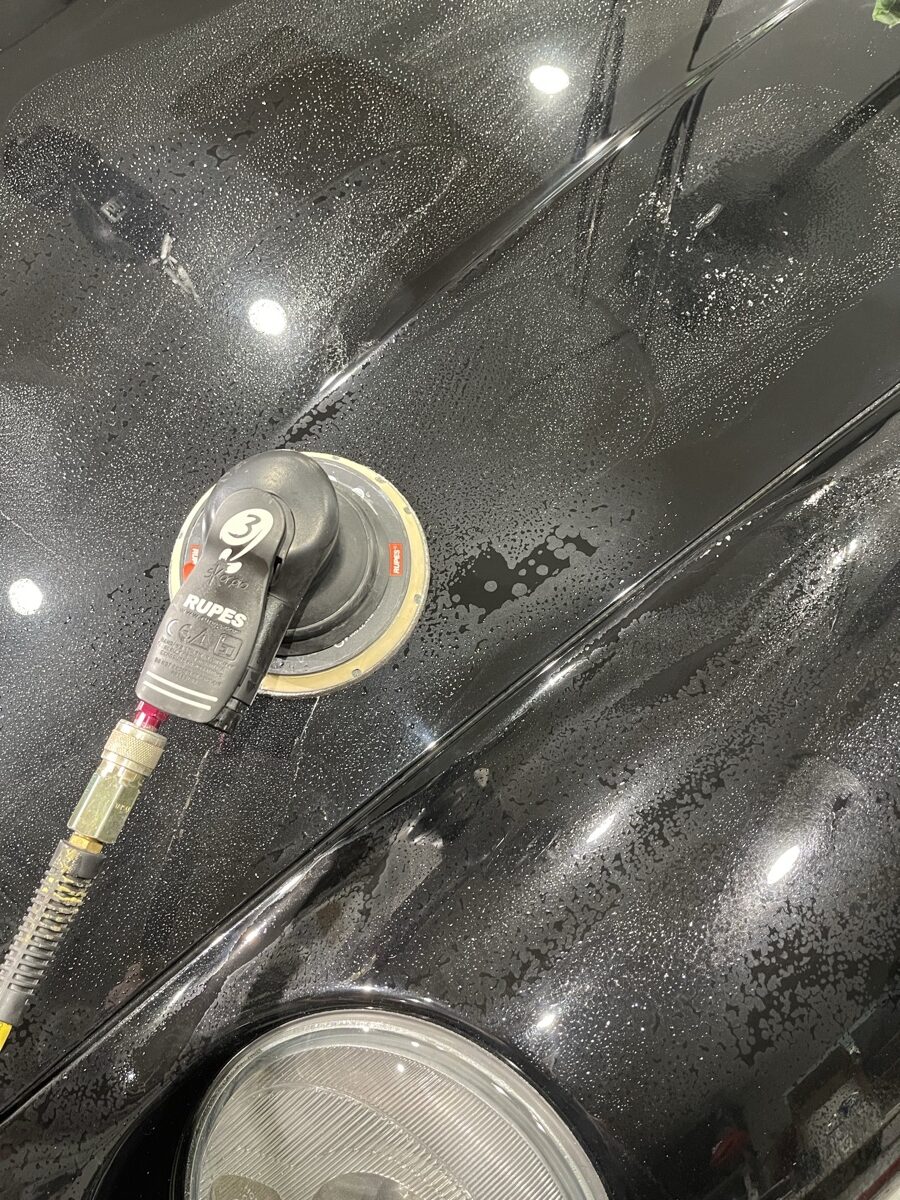
Using a dual-action or rotary polisher equipped with a cutting pad and compound, we systematically work through each panel of the vehicle. The compound contains diminishing abrasive particles that start aggressive and break down to finer particles as they are worked, allowing a single product to cut and refine simultaneously.
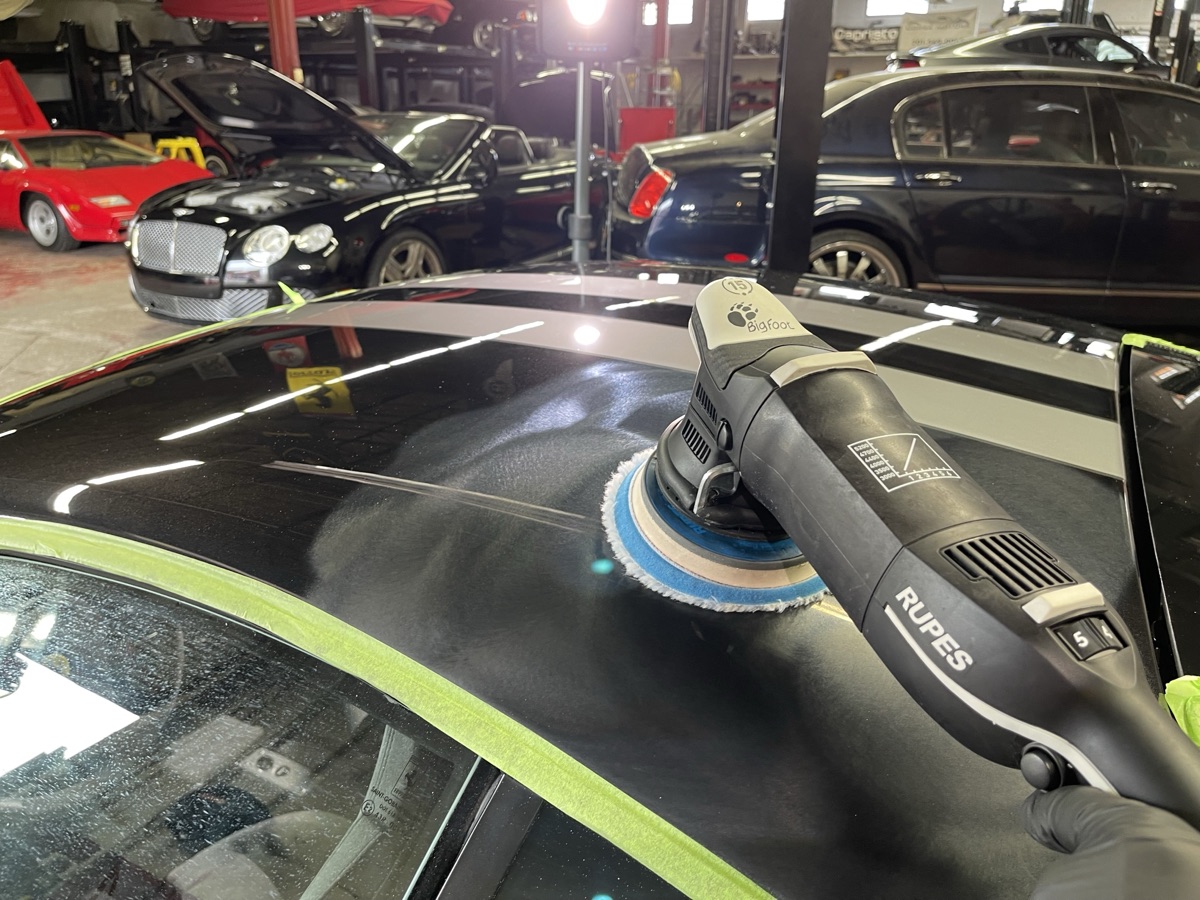
At CBA Detailing, we use professional-grade Rupes BigFoot and FLEX polishing systems — the same tools trusted by the world’s top detailers. These machines deliver the precise speed control, orbit pattern, and ergonomic design needed for safe, effective correction on everything from soft Japanese clear coats to hard German ceramic-reinforced finishes.
Step 7: Polishing (Refining Stage)
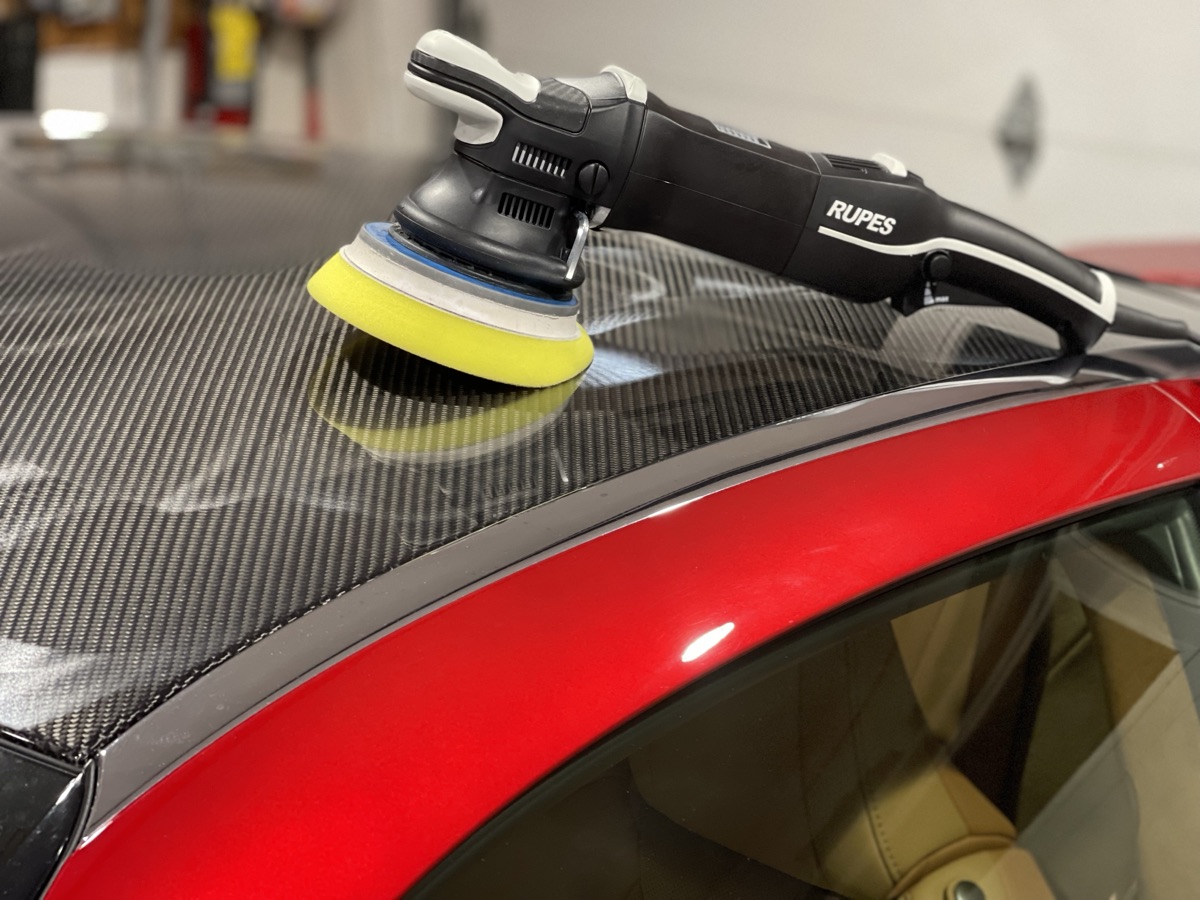
After compounding, the surface may have micro-marring or haze from the cutting stage. A finer polish and softer finishing pad are used to refine the surface to a mirror-like finish. This step develops the deep, wet-look gloss that defines professional paint correction. The polishing stage removes any remaining micro-scratches and brings out the full depth and clarity of the paint color.
Step 8: IPA Wipedown and Inspection
After polishing, we wipe down every panel with an isopropyl alcohol (IPA) solution. This removes all polish residue, fillers, and oils, revealing the true condition of the paint. Under high-intensity LED inspection lights, we examine every square inch of every panel to verify that the correction meets our standards. If any areas need additional attention, they are re-corrected before moving forward.
Step 9: Protection Application
Paint correction creates a perfectly clean, bare surface — and bare paint is vulnerable. Immediately after correction, we apply a protective layer. Options include:
- Ceramic wax for 6 months of hydrophobic protection
- Paint sealant for up to 12 months of durable protection
- Ceramic coating (such as Gtechniq, KAMIKAZE Collection, Ceramic Pro, or FIREBALL) for 2-5+ years of semi-permanent hardness protection
- Paint Protection Film (PPF) using LLumar Valor for physical barrier protection against rock chips, scratches, and environmental damage
The best results come from pairing paint correction with ceramic coating — the coating locks in the corrected finish and provides long-term protection against the environmental factors that caused the damage in the first place.
Why Professional Equipment Matters
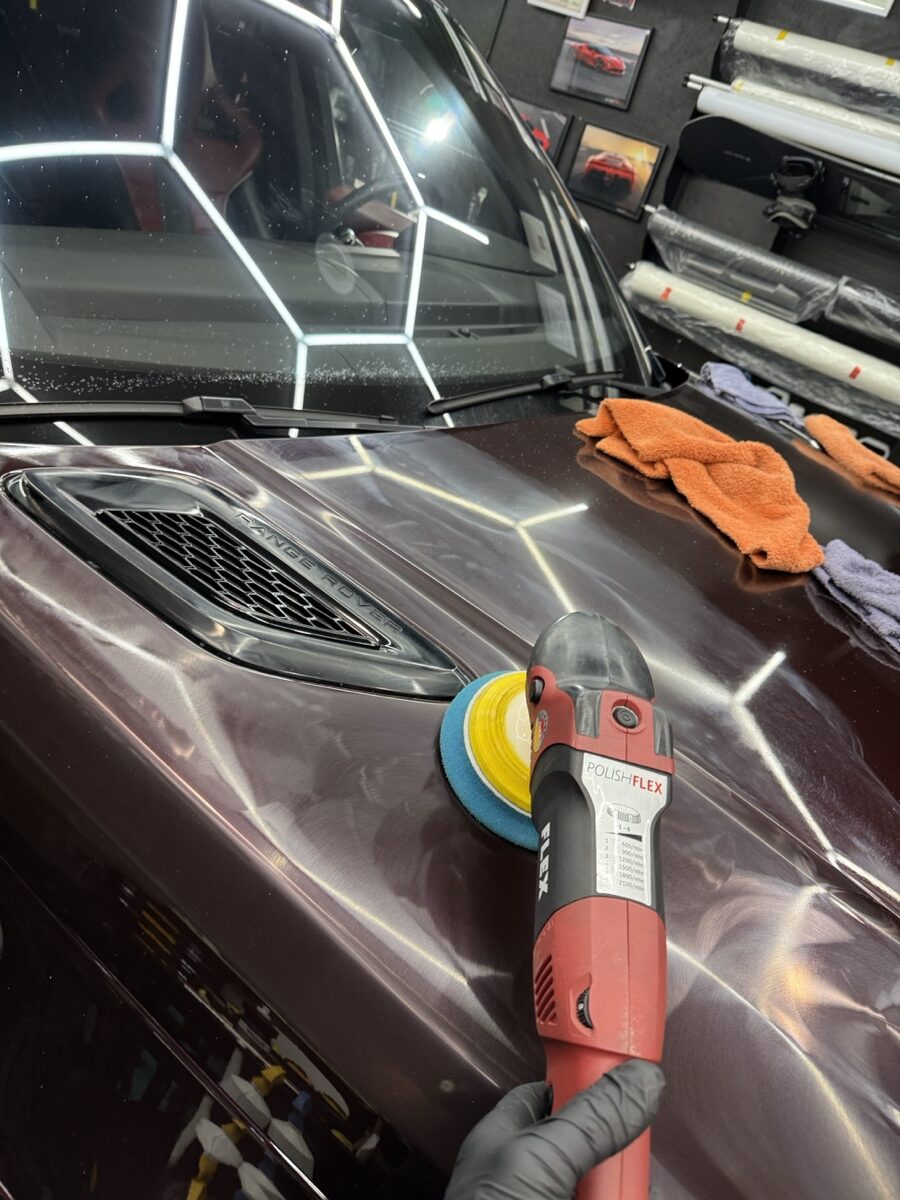
Paint correction is one of those services where the tools and environment make an enormous difference in the result. Here is why professional-grade equipment matters:
Polishing Machines
We use Rupes BigFoot dual-action polishers and FLEX rotary polishers — professional tools engineered specifically for paint correction. Consumer-grade polishers lack the torque consistency, orbit pattern precision, and speed control needed for safe, effective correction. Using the wrong machine can create holograms (buffer trails), burn through clear coat on edges, or fail to achieve adequate correction.
The Rupes BigFoot system uses a random orbital action that prevents heat concentration and reduces the risk of burning through the clear coat — making it safer for soft paints found on vehicles from manufacturers like Tesla, Subaru, Mazda, and some BMW models. The FLEX rotary provides the cutting power needed for harder clear coats found on Toyota, Lexus, and some Porsche models.
Controlled Lighting Environment
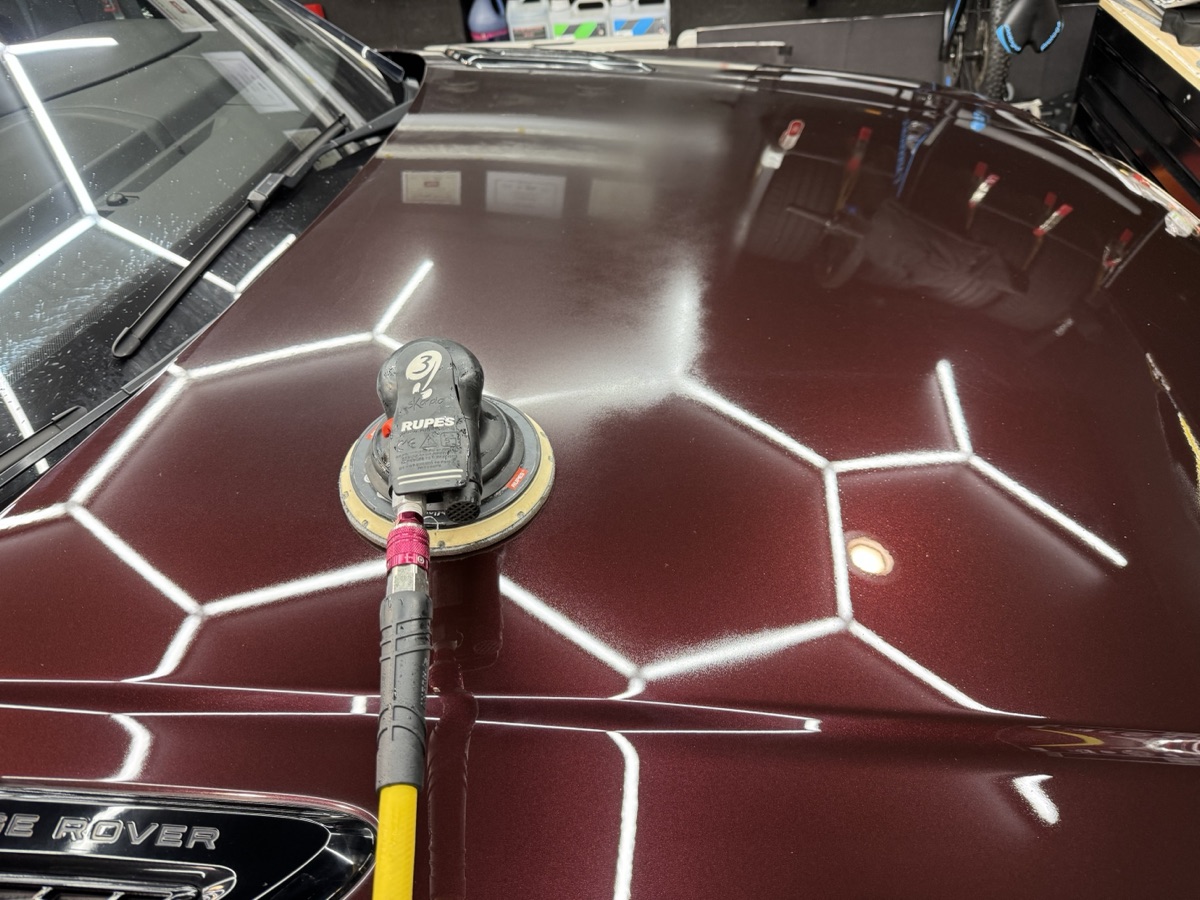
Our facility uses hexagonal LED panel inspection lights that replicate and exceed the intensity of direct sunlight. These lights reveal every swirl mark, scratch, hologram, and imperfection that would be invisible under normal garage lighting. Without proper inspection lighting, a detailer cannot see what they are correcting — and cannot verify whether the correction was successful.
Compounds and Polishes
Professional-grade compounds from manufacturers like Menzerna, Sonax, Rupes, and Koch Chemie use advanced diminishing abrasive technology that provides consistent cutting performance without excessive clear coat removal. Consumer-grade compounds often contain fillers that temporarily hide defects rather than removing them — the defects reappear after a few washes.
Paint Correction for Specific Vehicle Types
Luxury and Exotic Vehicles in Alpine, Closter, and Tenafly
Bergen County is home to one of the highest concentrations of luxury vehicles in the United States. Towns like Alpine, Demarest, Closter, and Tenafly have driveways lined with Range Rovers, Bentleys, Porsches, Mercedes-Benz, and BMWs. These vehicles represent significant investments, and their paint systems require specialized knowledge.
German vehicles (BMW, Mercedes, Porsche, Audi) typically have harder clear coats that are more resistant to scratching but require more aggressive compounds and longer correction times. British vehicles (Bentley, Rolls-Royce, Range Rover) often have thicker but softer paint systems that correct more easily but are also more prone to swirl marks from improper washing.
Teslas and Electric Vehicles
Tesla vehicles are known throughout the detailing industry for having exceptionally soft, thin clear coats. A Tesla Model 3 or Model Y driven through Paramus or Hackensack for just one year can accumulate more swirl marks than a Toyota Camry accumulates in five years. Paint correction for Teslas requires lighter compounds, softer pads, and a more conservative approach to avoid excessive clear coat removal.
Daily Drivers
For the majority of vehicles on Bergen County roads — Honda Accords, Toyota RAVs, Ford Explorers, Hyundai Tucsons — a 1-stage or 2-stage correction delivers dramatic results. These vehicles typically have moderate swirl marks from regular car wash visits and benefit enormously from professional correction followed by a ceramic wax or sealant for ongoing protection.
Paint Correction Cost in Bergen County, NJ
Paint correction pricing depends on several factors: the size of the vehicle, the condition of the paint, and the level of correction required. Here is a general guide to paint correction costs in Bergen County:
| Service | Sedan / Coupe | SUV / Truck | Exotic / Oversized |
|---|---|---|---|
| 1-Stage Enhancement | $350 – $550 | $450 – $700 | $600 – $900 |
| 2-Stage Correction | $600 – $900 | $800 – $1,200 | $1,000 – $1,800 |
| 3-Stage Correction | $1,000 – $1,500 | $1,200 – $2,000 | $1,800 – $3,000+ |
| Add Ceramic Coating | +$500 – $1,500 | +$700 – $2,000 | +$1,000 – $3,000 |
What Affects the Price?
- Vehicle size: A Porsche 911 has fewer panels than a Chevy Suburban. Larger vehicles require more time and product.
- Paint condition: Heavily neglected paint requires more stages, more compound, and significantly more time.
- Paint type: Soft paints (Tesla, Subaru, Mazda) require more careful, time-intensive work. Hard paints (Toyota, Lexus) require more aggressive products and longer working times.
- Correction level: Each additional stage roughly doubles the labor time.
- Protection package: Adding ceramic coating, PPF, or other protection after correction increases the total investment but provides long-term value.
Why Quality Paint Correction Is Not Cheap
Your vehicle’s clear coat is a finite, non-renewable resource. Factory clear coat is applied once at the factory and cannot be replicated exactly. Every paint correction removes a small amount of this clear coat. Choosing an inexperienced or underpriced service risks removing too much material, creating holograms, or burning through the clear coat entirely — damage that cannot be reversed without repainting.
Professional paint correction is not just polishing — it is a precision service performed by trained specialists using professional equipment in a controlled environment. The price reflects the expertise, time, tools, and products required to achieve a flawless result safely.
Not sure which correction level your vehicle needs? Contact CBA Detailing at (551) 358-5686 for a free paint assessment. We will inspect your paint under professional lighting and recommend the right approach — no obligation.
Does Your Car Need Paint Correction? A Self-Assessment
Not every vehicle needs a full multi-stage correction. Here is how to assess your paint’s condition:
The Sunlight Test
Park your vehicle in direct sunlight and examine the paint from multiple angles. Look for:
- Swirl marks: Circular scratches that appear as spider-webbing or concentric circles under direct light. If you see them, your paint needs correction.
- Fine scratches: Linear scratches visible in direct light. These are often from improper washing or drying.
- Water spots: Circular mineral deposits that feel rough to the touch. If they do not wash off, they have etched into the clear coat and need correction.
- Oxidation: A chalky, faded, or hazy appearance — especially on horizontal surfaces like the hood and roof. This indicates UV damage to the clear coat.
- Orange peel: A textured, bumpy appearance that looks like the skin of an orange. While this is a factory defect in some cases, severe orange peel can be reduced through wet sanding and correction.
The Flashlight Test
At night, hold a bright LED flashlight at a low angle against each panel. This simulates the intense inspection lighting used in professional shops and reveals defects that are invisible in normal conditions. If you see a web of fine scratches and swirl marks across every panel, your vehicle is a strong candidate for paint correction.
When You Might Skip Correction
- You are trading in or selling the vehicle within the next few months
- Your paint thickness gauge readings show the clear coat is already critically thin (below 80 microns total with base coat)
- The vehicle has single-stage paint (common on older vehicles) that requires specialized techniques
- The defects have penetrated through the clear coat into the base coat — these require touch-up paint or repainting, not correction
Paint Correction and Ceramic Coating: Why the Order Matters
If you are considering ceramic coating for your vehicle, paint correction is not optional — it is a prerequisite. Here is why:
Ceramic coatings like Gtechniq Crystal Serum, KAMIKAZE Collection ISM, Ceramic Pro, and FIREBALL create a semi-permanent bond with your clear coat. Once applied, the coating locks in whatever is underneath it — including any swirl marks, scratches, or imperfections that were not removed first.
Think of it this way: ceramic coating is like laminating a document. If there are smudges on the paper before you laminate it, those smudges are sealed in permanently. Paint correction is the process of cleaning the document before lamination.
At CBA Detailing, every ceramic coating package includes paint correction as a standard part of the process. We will never apply a coating over uncorrected paint, because the result would not meet our standards — or yours.
The same principle applies to Paint Protection Film (PPF). Before applying LLumar Valor PPF, the paint must be corrected to ensure a flawless surface underneath the film.
How to Maintain Your Paint After Correction
Paint correction permanently removes existing defects, but new defects can develop if proper washing and maintenance practices are not followed. Here is how to protect your investment:
Washing Best Practices
- Use the two-bucket wash method: One bucket for soapy water, one for rinsing your wash mitt. This prevents transferring grit from the car back onto the paint.
- Never use automatic brush car washes. This is the single fastest way to re-introduce swirl marks.
- Use touchless car washes if you cannot hand wash. While not as thorough, they will not scratch the paint.
- Use a dedicated car wash soap — never dish soap, which strips protection.
- Dry with a clean, high-quality microfiber drying towel or a filtered air blower.
Seasonal Maintenance for Bergen County
- Spring: Remove pollen buildup promptly. Bergen County’s peak pollen season runs from mid-April through May and pollen is acidic enough to etch clear coat. Rinse your vehicle before wiping — never dry-wipe pollen.
- Summer: Wash more frequently to remove bug residue, bird droppings, and tree sap before they etch. Park in shade when possible to reduce UV exposure.
- Fall: Remove fallen leaves immediately — wet leaves contain tannins that stain paint. Wash before and after leaf season.
- Winter: Bergen County typically begins road salt application in late November. Rinse road salt within 48 hours of heavy salting. Avoid brushing snow off with abrasive scrapers — use a foam brush or snow blower.
When to Schedule Maintenance
If you have ceramic coating, schedule a maintenance detail every 6-12 months to decontaminate the surface and apply a ceramic boost spray. If you have paint sealant or wax, reapply every 3-6 months depending on the product.
Bergen County Service Areas
CBA Detailing is located at 315 East Madison Ave, Dumont, NJ 07628, in the heart of Bergen County. We serve vehicle owners throughout Bergen County, including:
Northern Bergen County: Closter, Demarest, Alpine, Norwood, Haworth, Northvale, Rockleigh, Old Tappan
Central Bergen County: Tenafly, Englewood, Englewood Cliffs, Bergenfield, Dumont, New Milford, Oradell, River Edge, Emerson
Eastern Bergen County: Leonia, Teaneck, Hackensack, Fort Lee, Palisades Park, Edgewater, Fairview
Western Bergen County: Paramus, Ridgewood, Glen Rock, Fair Lawn, Saddle Brook, Wyckoff, Ho-Ho-Kus, Waldwick
Whether you drive a daily commuter through Hackensack traffic or a weekend exotic from Alpine, our team delivers the same meticulous attention to every vehicle. Most Bergen County locations are within a 15-minute drive of our Dumont facility.
How to Choose a Paint Correction Professional
Not all detailers are created equal, and paint correction is a high-skill service where the wrong choice can cause permanent damage. Here is what to look for:
Questions to Ask
- What paint thickness measurement tools do you use?
- What polishing machines and compounds do you use? (Look for professional brands: Rupes, FLEX, Menzerna, Sonax, Koch Chemie)
- Do you perform a test spot before committing to full correction?
- What kind of lighting do you use for inspection?
- Do you photograph or document your work before and after?
- What protection options do you offer after correction?
Red Flags
- Prices significantly below market rate (below $300 for full correction) — this usually means corners are being cut
- No paint thickness measurement before starting
- Working outdoors or in a poorly lit environment
- Using only rotary polishers on all vehicles (rotary can burn through paint in inexperienced hands)
- Promising to “remove all scratches” — deep scratches that penetrate the base coat cannot be corrected by polishing
- No before-and-after documentation
At CBA Detailing, we check every box on this list. We use Rupes and FLEX professional systems, measure paint thickness on every vehicle, perform test spots, work under hexagonal LED inspection lighting, and document every job with before-and-after photography.
Frequently Asked Questions
What is paint correction?
Paint correction is the process of permanently removing surface-level imperfections from your vehicle’s clear coat — including swirl marks, fine scratches, water spots, bird dropping etchings, and oxidation — using machine polishing with specialized compounds and pads. Unlike waxing or hand polishing, which temporarily mask defects, paint correction physically removes them by leveling the clear coat surface.
How much does paint correction cost in Bergen County, NJ?
Paint correction in Bergen County typically ranges from $350-$550 for a single-stage enhancement on a sedan, $600-$1,200 for a two-stage correction, and $1,000-$3,000+ for a three-stage correction on larger or exotic vehicles. Pricing depends on vehicle size, paint condition, correction level needed, and any additional protection (ceramic coating, PPF) applied afterward.
Is paint correction worth it?
Yes. Paint correction restores your vehicle’s original factory finish, dramatically improves appearance, and increases resale value. It is also the essential foundation for ceramic coating and PPF installation. Vehicles that have been professionally corrected and coated maintain their appearance for years with minimal maintenance, making it a long-term investment rather than an expense.
What is the difference between 1-stage and 2-stage paint correction?
A 1-stage correction uses a single polish or compound to remove approximately 50-70% of surface defects — ideal for newer vehicles with light swirl marks. A 2-stage correction uses a cutting compound to remove deeper defects, followed by a finishing polish to refine the surface, achieving 85-95% defect removal. The 2-stage process takes roughly twice as long but delivers significantly superior results.
Do I need paint correction before ceramic coating?
Yes. Ceramic coatings bond semi-permanently with the clear coat and lock in whatever surface condition exists at the time of application. Applying ceramic coating over uncorrected paint seals in swirl marks, scratches, and imperfections permanently. Paint correction ensures you are protecting a flawless surface, not preserving defects under a coating.
Will swirl marks come back after paint correction?
Paint correction permanently removes existing swirl marks by physically leveling the clear coat. However, new swirl marks can develop over time from improper washing techniques, automated car washes, and abrasive drying methods. Following proper maintenance practices and protecting the paint with ceramic coating significantly reduces the chance of new defects forming.
How long does paint correction take?
A single-stage enhancement typically takes 4-6 hours. A two-stage correction requires 8-14 hours, and a full three-stage correction can take 16-24+ hours. These times vary based on vehicle size, paint condition, and the level of correction needed. We never rush the process — achieving a flawless result requires time and patience.
Can paint correction remove deep scratches?
Paint correction can remove scratches that are contained within the clear coat layer. The simple test: if you can catch your fingernail in the scratch, it has likely penetrated through the clear coat into the base coat or primer. Scratches that deep require touch-up paint or repainting — they cannot be removed by polishing alone.
How many times can paint be corrected?
This depends on the thickness of the remaining clear coat. Factory paint typically has 40-80 microns of clear coat, and each correction removes 2-5 microns. Using a paint thickness gauge, we measure the available clear coat before every correction to ensure there is sufficient material for safe removal. Most vehicles can undergo 3-5 professional corrections over their lifetime.
Do new cars need paint correction?
Often, yes. New vehicles frequently arrive from the factory or dealership with swirl marks, buffer trails from dealer prep, transport damage, and varying levels of orange peel. Many new car owners in Bergen County bring their vehicles to us before the first wash — they want the paint corrected and protected with ceramic coating or PPF before any environmental damage occurs.
What is the difference between paint correction and buffing?
Paint correction is a precision, multi-step process performed by trained specialists using controlled techniques, professional equipment, and proper inspection lighting. “Buffing” is a general term that often refers to a quick, single-step polish that may improve appearance temporarily but frequently leaves holograms, buffer trails, and incomplete correction.
How do I know if my detailer did a proper paint correction?
Ask to see the paint under inspection lighting (LED panel lights or a bright flashlight at a low angle) after the correction is complete. The surface should be free of swirl marks, holograms, buffer trails, and haze. Request before-and-after photos and paint thickness measurements. If your detailer cannot or will not show you the paint under inspection lighting, that is a significant red flag.
Schedule Your Paint Correction Consultation
Whether you are searching for paint correction near me in Closter, Tenafly, Paramus, Hackensack, Alpine, Teaneck, or anywhere in Bergen County, CBA Detailing is ready to restore your vehicle’s paint to its factory best. We offer free, no-obligation consultations where we assess your paint’s condition under professional LED inspection lighting, recommend the appropriate correction level, and provide a detailed estimate.
At CBA Detailing, we use Rupes and FLEX professional polishing systems, measure paint thickness on every vehicle, perform test spots before full correction, and document every job with before-and-after photography. We check every box that matters.
CBA Detailing
315 East Madison Ave, Dumont, NJ 07628
Phone: (551) 358-5686
Email: cbadetailing@gmail.com
Hours: Monday-Friday 8AM-6PM | Saturday 9AM-4PM
Where Every Detail Matters.